Most relay selection is relatively straightforward. A coil is energized, a contact changes state, and the contact stays where it is for as long as the coil is powered. However, selection gets harder when the relay has to perform a specific logical task.
A single relay is not typically the correct choice for something like this. Two or three relays must be wired together until the combination produces the needed behavior, or a programmable controller is specified. Both add panel space, wiring, and points of failure. A one-shot relay, on the other hand, meets this requirement; it accepts one input and produces one output of a duration set on the device.
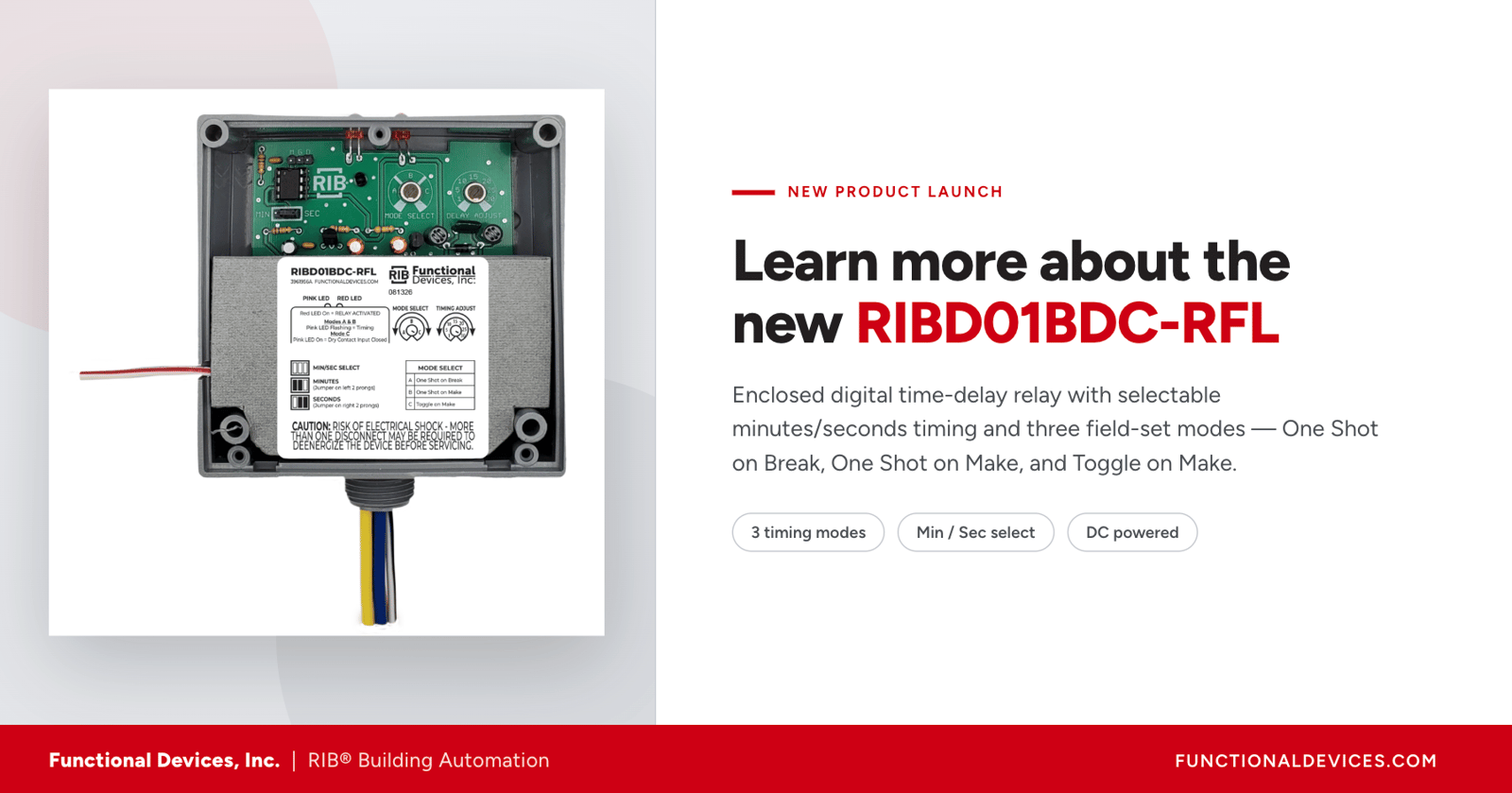
Previously, Functional Devices, Inc. could not easily fulfill that need. Our new addition to the RIB® (Relay-In-a-Box®) dry contact input line, the RIBD01BDC-RFL, meets that specification directly.

RIBD01BDC-RFL One-Shot Relay Specifications
A one-shot relay is specified under several names: single shot relay, pulse relay, pulse timer relay, and trigger timer relay.
| Power Input | 120 Vac |
|---|---|
| Output | 20 A SPDT contact. Both normally open and normally closed switching are available. The contact switches loads directly or interfaces with contactors, starters, building automation system (BAS) controllers, and other control equipment. |
| Input | A dry contact initiates operation, which allows the relay to be driven by pushbuttons, thermostat contacts, BAS outputs, flow switches, pressure switches, and occupancy sensors. |
| Timing | Adjustable ranges of 1–30 seconds or 1–30 minutes |
| Modes | Rising-edge one-shot, falling-edge one-shot, and two-wire momentary latching |
Rising-Edge and Falling-Edge One-Shot Modes
A dry contact input has only two states: open or closed. When it goes from open to closed, that is the rising edge. When it goes from closed to open, that is the falling edge. The two one-shot modes differ in which transition of the input starts the timer.
A single shot rising-edge relay begins timing when the dry contact input closes. A momentary pushbutton press and a maintained switch thrown to its closed position produce the same result: one output pulse of a set duration.
A single shot falling-edge relay begins timing when the input opens. The output is produced after the initiating condition has gone away, which is what a post-shutdown purge sequence requires.
The RIBD01BDC-RFL does both. These modes are not interchangeable within a sequence: a relay set to rising-edge detection in a purge application would run the fan while the equipment was still operating and stop before it shut down, which is the opposite of the intended behavior.
Two-Wire Latching From a Momentary Contact
The same device also serves as a two-wire input latching relay, holding a maintained state from a momentary input. A single momentary closure latches the output ON; the next closure unlatches it and returns the output to OFF. Both signals arrive on the same pair of input wires, so one pushbutton or one BAS output can control the state.
Latching relays are more commonly wired with separate latch and unlatch signals, which requires an additional conductor and a controller capable of driving two outputs. The two-wire arrangement is useful for occupancy overrides, lighting control, equipment enable commands, maintenance modes, and fan control, where a maintained state has to be held using only a momentary pushbutton or contact closure.
One-Shot Relay Applications
Fan Purge Cycles: With falling-edge detection, the timer begins when the equipment shuts down and the fan continues to run for the set period.
Door Release Control: A momentary button press produces a release output of fixed length, independent of how long the button is held.
Pump Exercise Routines: A contact closure runs the pump for a set interval to prevent it from sitting idle.
Damper Positioning: A single input event drives the actuator for a fixed period rather than for as long as the signal is present.
Alarm Annunciation: An alarm contact produces an output of known duration, so the annunciation does not persist for the length of the alarm condition.
Chemical Feed Systems: A metered dose is delivered by running the feed for a set time from one triggering contact.

One-Shot Relay vs. Time Delay Relay
A time delay relay adds a delay at one edge of an input. With delay-on-make and delay-on-break functions, the output is held for as long as the input remains present, with the delay inserted at either the beginning or the end.
A one-shot relay does not track the input at all. Output duration is set on the device and is unaffected by how long the input stays closed.
Frequently Asked Questions About One-Shot Relays
Which relay runs a fan after equipment shuts off?
A one-shot relay set to falling-edge detection turns the fan on once the equipment has stopped running. Timing begins when the dry contact input opens, so the purge period starts at shutdown. On the RIBD01BDC-RFL, the duration of that period is adjustable over 1–30 seconds or 1–30 minutes.
What is the difference between rising-edge and falling-edge detection?
Rising-edge detection starts the timer when the dry contact input closes. Falling-edge detection starts the timer when the input opens, which places the output after the initiating condition has ended. Purge sequences that have to run once equipment has stopped require falling-edge detection.
Can a one-shot relay replace a time delay relay?
Not in every case. A time delay relay holds its output for as long as the input is present, with a delay added at one edge. A one-shot relay produces a fixed output length regardless of the input. Where a maintained output is required, a time delay relay applies.
How does two-wire latching work with a single pushbutton?
Both the latch and unlatch commands travel on the same pair of input wires. The first momentary closure latches the output ON and the next closure returns it to OFF, so one pushbutton toggles a maintained state without a second conductor or a second controller output.
What timing range does the RIBD01BDC-RFL provide?
The RIBD01BDC-RFL provides adjustable timing ranges of 1–30 seconds or 1–30 minutes, set on the device.
Specifying the RIBD01BDC-RFL One-Shot Relay
Functional Devices’ RIBD01BDC-RFL one-shot relay combines three functions on one dry contact input: it facilitates a timed output when the contact closes, a timed output when it opens, and a maintained state that toggles due to successive closures. What would’ve previously needed a series of two or three relays or a small controller to achieve now only requires one device.
To specify a one-shot relay for your project, see the RIBD01BDC-RFL product page or find an authorized Functional Devices distributor near you.