Many commercial buildings still rely on lighting control systems installed years—or sometimes even decades—ago. While those systems may still function, they often lack the flexibility, connectivity, and energy intelligence that today’s facilities demand. As expectations around efficiency, data visibility, and occupant comfort increase, legacy lighting controls can quickly become a limiting factor.
Upgrading to smart lighting automation does not always require a complete system overhaul. With the right integration strategy and control components, existing infrastructure can often be modernized to support centralized management, scheduling, occupancy response, and energy optimization. The key is understanding how to bridge older systems with current automation platforms in a practical and cost-effective way.
Many of Functional Devices’ customers want to retrofit updated technologies into their conventional BAS. We’d love to help you understand the ins and outs of upgrading your automation and lighting controls, so give us a call.
Now, let’s talk about legacy and modern lighting systems and how to best incorporate new technologies into your existing BAS for better safety, performance, and longevity.
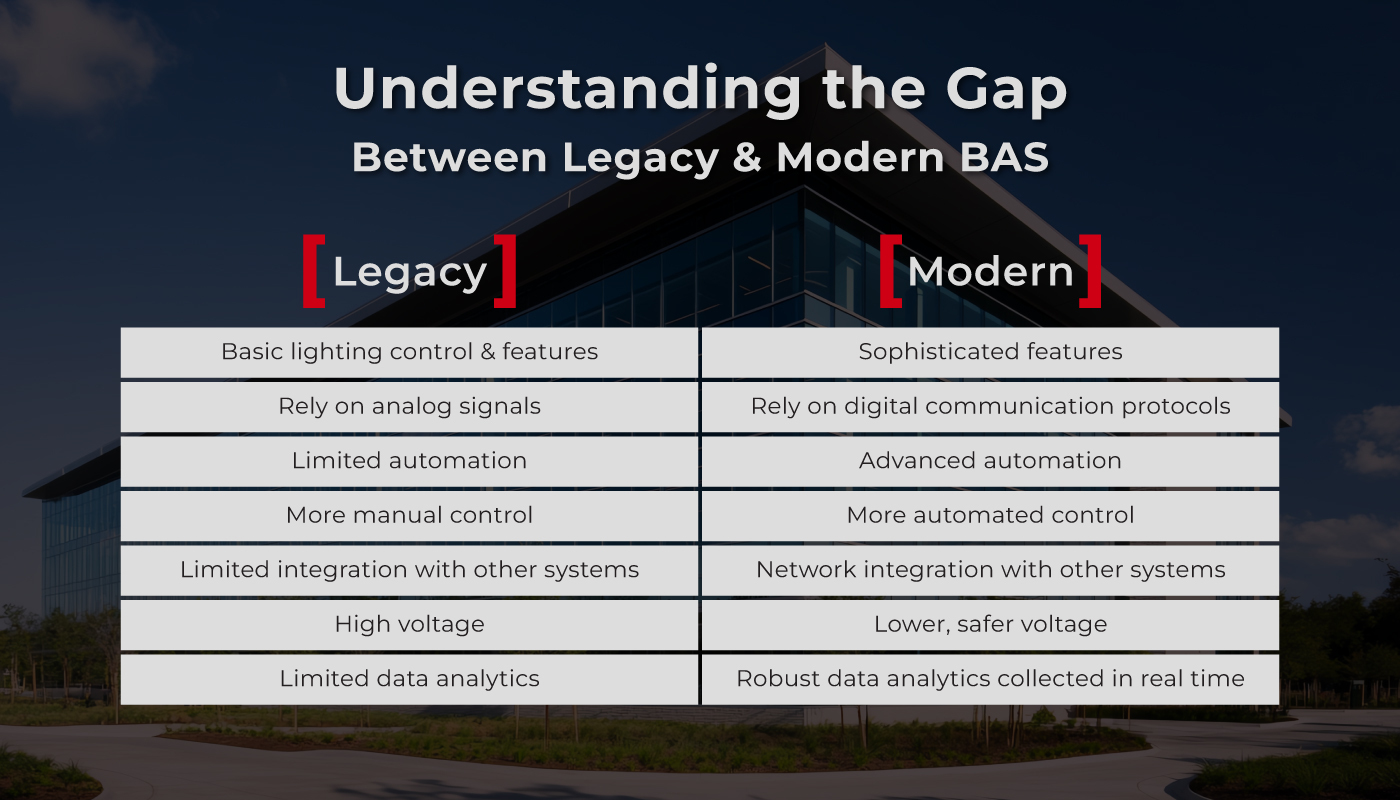
Understanding the Gap Between Legacy and Modern BAS
Perhaps you’re dealing with signal incompatibility, limited data visibility, issues with integration, or wasted energy and time within your BAS. These are all common issues that cause owners and managers to begin the search for something better.
Legacy lighting systems are found throughout commercial and industrial environments. Some of the most common locations are healthcare facilities, educational institutions, government buildings, warehouses, garages, and older office spaces.
While legacy systems might depend on components such as simple electromechanical relays, analog dimmers, basic occupancy sensors, and outdated programmable logic controllers (PLCs), modern smart systems utilize digital controls, smart relays, advanced occupancy sensors, and wireless networking.
Considerations for Cross-Generational Lighting Controls
Now that you understand the main differences between legacy and modern lighting controls, turn your eye to assessing your existing infrastructure and defining your integration goals.
Broadly speaking, when bridging the gap between old and new, consider choosing lighting devices that offer:
- Interoperability/Hybrid functionality
- Modular configuration
- Scalability
- Flexibility in control options
- Robust security measures
- Energy efficiency
- Intuitive interfaces and user-friendly design
- Easy maintenance
You want future-proof components that will operate smoothly and efficiently without significant updates to your building’s existing framework. Sounds too good to be true? Don’t worry; such devices exist!
Key Technologies Enabling Seamless Integration and Smoother Automation
So you know you want to update your legacy lighting system and that smart relays and advanced occupancy sensors are likely involved, but what else? Is that it? Let’s explore the top technologies you can use to upgrade lighting automation.
- Smart relays and interface modules allow old analog systems to work with new digital devices (like advanced occupancy sensors), translate analog signals to digital, and enable integration of features.
- Protocol converters and gateways translate signals between legacy systems and modern networks (e.g., BACnet, Modbus, KNX, Ethernet, DALI), allowing centralized control and monitoring.
- Wireless controls and sensors allow the use of new cybersecure technologies without requiring a costly rewire of existing infrastructure.
- Digital timers and dimming modules connect to existing wiring, layering smart upgrades onto older lighting circuits, improving energy efficiency, and offering automated control.
Retrofitting your lighting controls involves either replacing or layering devices. Replace the devices you can with interoperable smart options. Then, layer new technologies into the existing frameworks.
Retrofitting in Practice: Balancing Innovation with Preservation
There are many approaches to retrofitting new technologies into old systems, and we don’t have time to get into all of them here; however, here are some specific ways facility managers are balancing innovation and preservation.
Examples include:
- Installing occupancy and daylight sensors in series with existing manual controls
- Replacing fluorescent bulbs with LEDs through retrofit kits, tubular LED lamps, or new LED luminaires
- Upgrading control panels while retaining existing wiring
- Integrating IoT lighting controls with magnetic ballasts or legacy drivers
- Replacing traditional dimmer modules with constant-current modules
- Adding automation with centralized smart relays
- Upgrading any other controls with self-powered wireless options as much as possible
Before proceeding, you must consider code compliance, load compatibility, safety, and budget. If you’re unsure about any specifics, contact the product's manufacturer!
5 Benefits of Modern BAS Systems
Improved Energy Efficiency
Modern building automation systems continuously monitor and adjust HVAC, lighting, and other loads based on occupancy, schedules, and real-time conditions. This reduces wasted energy and helps facilities lower operating costs without sacrificing performance.
Greater System Visibility
Today’s BAS platforms provide centralized dashboards and detailed reporting. Facility managers gain clearer insight into equipment status, alarms, and trends, allowing for faster troubleshooting and more informed decision-making.
Enhanced Occupant Comfort
Smart controls respond dynamically to temperature changes, daylight levels, and usage patterns. This creates more consistent indoor environments that improve comfort and productivity for building occupants.
Simplified Maintenance and Diagnostics
Modern BAS systems support remote access and automated alerts. Maintenance teams can identify issues earlier, respond more quickly, and reduce downtime before small problems turn into larger repairs.
Scalability for Future Growth
A well-designed BAS can expand as building needs change. Whether adding new zones, integrating additional equipment, or incorporating IoT devices, modern systems are built to adapt without requiring a complete overhaul.
Partner with Automation Specialists
Modernizing legacy lighting controls is a practical step toward improving efficiency and extending the life of your building systems. In many cases, existing infrastructure can remain in place while targeted upgrades introduce smarter control, better visibility, and stronger energy performance. You do not always need a full replacement to achieve meaningful results.
Functional Devices can help evaluate your current setup and identify retrofit opportunities that make sense for your facility and budget. With decades of experience supporting building automation systems, our team provides reliable lighting control and automation devices that connect legacy equipment to modern platforms. Contact us to discuss your project and explore the next step forward.
About Functional Devices, Inc.
Leaders in the Industry
The world was a very different place in 1969, when Functional Devices, Inc. was founded by engineer and electronics enthusiast Albert Rittmann, but our commitment to evolution and versatility has allowed us to remain a key player in the building automation and lighting controls industry for over 55 years.
Today, as we embrace emerging technology and lean into the future of building automation, our products are still manufactured in the USA with global materials, and we are still committed to our mission of enhancing lives in buildings and beyond. Back in 1969, Albert could never have predicted the technological advances we live with today, but with the groundwork he laid and the vision of his successors, Functional Devices has adapted and grown into a company that can handle anything.