
Current sensing is a fundamental building block of effective control and monitoring in automation systems. When you need to know whether a load is running or how much current it’s drawing, the right current sensor can make all the difference. Functional Devices’ lineup of RIB® current sensors deliver dependable performance in a compact form, with options suited for everything from new installations to retrofits and varying wiring preferences.
In the field, engineers and technicians often call in with questions about which model will work best for their application. That’s because the differences between solid core versus split core designs, wired versus terminal connections, and fixed versus adjustable thresholds aren’t just technical details—they affect how smoothly an installation goes and how accurate the feedback will be once it’s up and running. This guide walks through those key choices so you can select a RIB® current sensor that fits your system’s needs without unnecessary surprises.

Solid Core vs. Split Core
When somebody calls in looking for a current sensor to meet their desired specifications, I usually start by asking: "Would you like a solid or split core current sensor?" Asking that question helps me to narrow the options rather quickly.
If the application is in a new installation, I suggest a solid core model. It's a good choice because there will be less of a chance that wires will need to be cut to install the current sensor. If the installation is a retrofit, I typically suggest split core. In this scenario, the current sensor core may be "split" apart (opened) and the wire may be inserted into the core to be sensed.
The solid core does have an advantage in terms of the low end of the sensing range: 0.25–0.5 Amp for solid core vs. 0.5–0.75 Amp for split core. The low end of the sensing range determines when the normally open dry contact output of the current sensor will close.
Wires vs. Terminals
Another question that I typically ask is whether or not there's a desire for a wired connection or terminal connection to the current sensor. To be honest, this typically falls in the area of personal preference. If one does not mind using wire nuts to make the connection to the sensor output, a wired model may be suggested. If terminals help to clean up the wiring of the device and a certain kind of wire color is preferred, one may order a model with terminals ("T" in the model name). The terminals have an opening that is large enough to allow a 14–22 AWG sized wire to be terminated.
Fixed Threshold vs. Adjustable Threshold
Probably the most important question I ask someone is whether they want the threshold of the current sensor to be at a fixed value or an adjustable value. If one has ensured that the load being monitored does not consume any current until activated, and there's no chance for a lower current level to be sensed after it is on, then a fixed model ("F" in the model name) may be chosen. If one finds that there is a leakage or standby current that is large enough to be detected by the current sensor, it would be wise to choose an adjustable model ("A" in the model name).
The adjustable model has the ability to be adjusted to "look over" the leakage or standby current so that a false positive is not caused. Specific thresholds and other specifications may be found on the respective product data sheets on our website.
What Is That Little Plastic Tab in the Box with the Current Sensor?
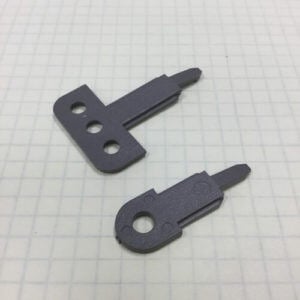
Here within the company, we call those little plastic pieces “mounting tabs,” and their name describes their use. Perhaps a dangling current sensor on a wire is unsightly within the panel or wherever else the current sensor is used. Use this little mounting tab to fasten the current sensor to the wall or a face within a panel! Use the appropriate sized screw(s) to fasten the tab to the mounting surface, and then slide the current sensor onto the tab. Easy as that! Now that looks better, doesn’t it?
I hope this blog helps bring to light some of the great features associated with our RIB current sensors and how they can enhance building automation systems.
About Functional Devices, Inc.

Functional Devices, Inc., located in the United States of America, has been designing and manufacturing quality electronic devices since 1969. Our mission is to enhance lives in buildings and beyond. We do so by designing and manufacturing reliable, high-quality products for the building automation industry. Our suite of product offerings include RIB relays, current sensors, power controls, power supplies, transformers, lighting controls, and more.
We test 100% of our products, which leads to less than 1 out of every 16,000 products experiencing a failure in the field.
Simply put, we provide users of our various products confidence and peace of mind in every box.