People confuse UL924 vs. UL1008 all the time, and it’s easy to see why. Both standards govern emergency lighting systems. Both appear on relay spec sheets. And getting one where you needed the other can mean a failed inspection or a non-compliant installation. The distinction between them comes down to one fundamental question: does the device need to bypass/override a control, or does it need to transfer power from one source to another?
Here's a plain-language breakdown of what each standard requires, when each applies, and which Functional Devices, Inc. products are listed under each.

What Is UL924?
UL924 is the standard for Emergency Lighting and Power Equipment—specifically for Automatic Load Control Relays (ALCRs) and bypass/shunt relays. A UL924-listed device is designed to ensure that emergency lighting fixtures turn on and stay on at full brightness when normal utility power is lost, regardless of the position of a wall switch, dimmer, or other control.
A UL924 ALCR does not transfer power between two sources. It sits on a circuit that is already connected to emergency power and overrides the control device when normal power drops out. When normal power is present, the device is in the normal mode and the emergency circuit lighting follows the status of the surrounding Normal lighting—allowing lights to be switched or dimmed as usual. When normal power is lost, the device is in Emergency mode and the lighting load is forced on regardless of the control state.
UL924 devices are governed under NEC 700.26 and NFPA 101, and are frequently required wherever emergency lighting loads would like to be controlled by dimmers, occupancy sensors, or automated lighting panels.
Common UL924 applications include:
- Bypassing a dimmer or wall switch on an emergency lighting circuit
- Overriding a lighting control panel or relay cabinet during an emergency
- Integrating with a 0–10V or DALI dimming system to force full brightness during power loss
- Accepting a fire alarm dry-contact input to trigger emergency lighting independently of utility power status
What Is UL1008?
UL1008 is the standard for Transfer Switches, and Branch Circuit Emergency Lighting Transfer Switches (BCELTS) is a subset within that standard. A UL1008-listed device transfers the electrical load from the normal power source to an emergency power source (such as a generator or inverter) when normal power is lost.
Where a UL924 ALCR bypasses a control, a UL1008 BCELTS performs an actual power transfer. It has connections to both the normal panel and the emergency panel, and it switches between them under fault conditions. Because of this, UL1008 devices undergo fault-current evaluation and must handle the conditions that arise when two potentially out-of-phase power sources are involved—requirements that UL924 devices are not designed to meet.
UL1008 devices are appropriate when:
- Emergency fixtures share a circuit with normal lighting and must transfer to backup power on outage
- Line-voltage dimming is in use and only a subset of fixtures on the circuit are designated as emergency fixtures
- The installation is in a space where loss of the emergency panel alone would leave the area in total darkness (NEC 700.16 consideration)
- An AHJ requires that emergency illumination continue even if the emergency panel is lost, since a UL1008 device can maintain power from either source
It's important to note that UL1008 devices require both the normal and emergency circuits to be sized to carry the full emergency lighting load, since power is drawn from one or the other at any given time.
Key Differences and When Each Applies
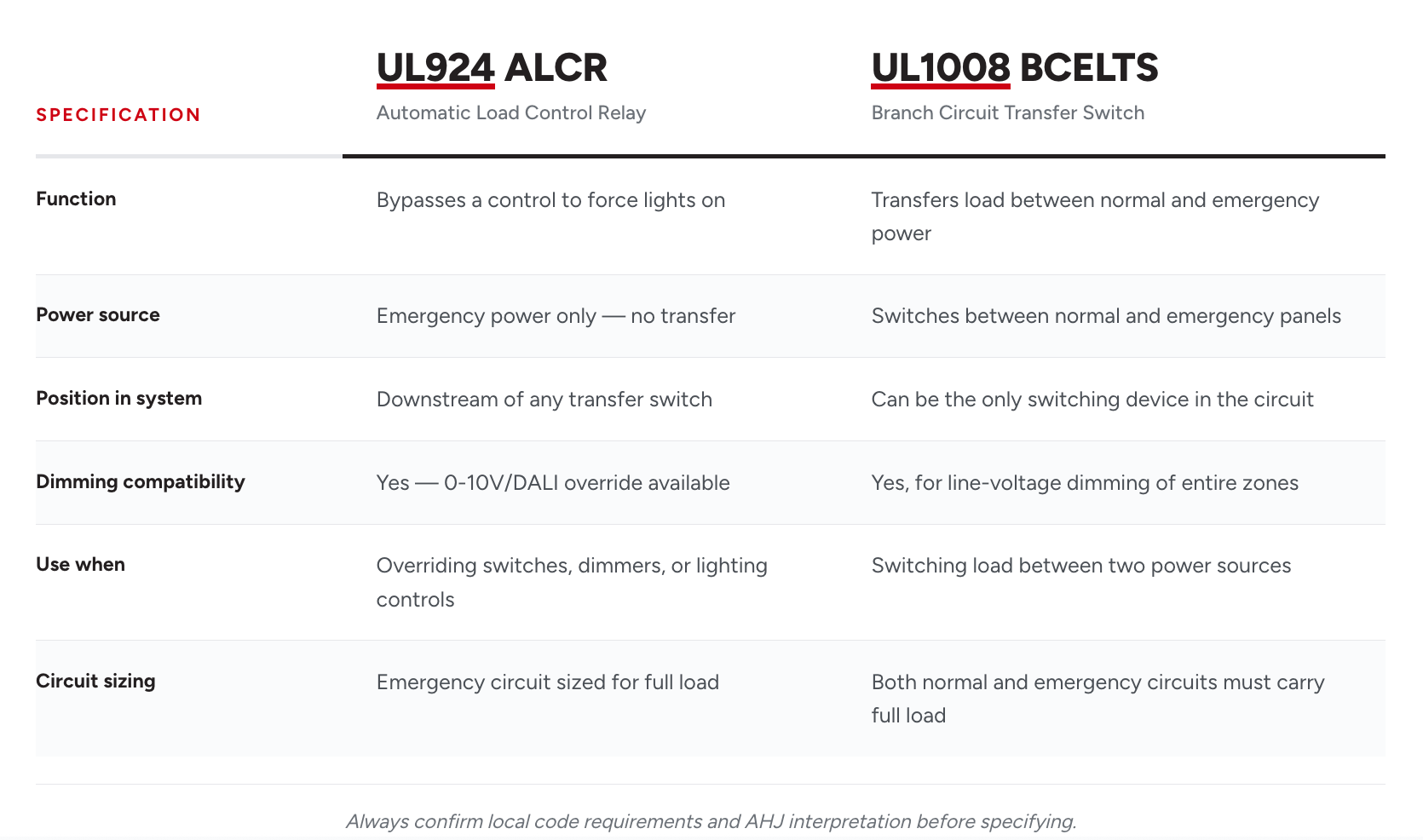
If your job is to make sure the lights come on when normal power drops—bypassing whatever control is in the way—you need a UL924 ALCR. If your job is to move the load from one panel to another, you need a UL1008 BCELTS.
In many buildings, both types are present. A UL1008 transfer switch often handles the upstream power transfer at the panel level, while UL924 ALCRs sit downstream on individual branch circuits to override any controls on those circuits.
Code Requirements for Emergency Lighting Relays
Emergency lighting systems in commercial facilities must comply with NEC Article 700, which sets the framework for emergency power and lighting systems, and NFPA 101 (Life Safety Code), which establishes egress lighting requirements. Together, these codes define where emergency lighting is required, how long it must operate, and what equipment must be used.
Key code requirements that drive UL924 and UL1008 selection include:
NEC 700.16 requires that no single failure (such as a burned-out lamp) leaves any required space in total darkness. In spaces where all fixtures are emergency fixtures and there is no other light source, some AHJs require UL1008 BCELTS devices, since they will maintain illumination if either the normal or emergency panel is still energized. A UL924 ALCR in the same scenario cannot maintain emergency lighting if the emergency panel fails.
NEC 700.26 specifically covers automatically controlled emergency lighting and establishes that ALCRs (UL924 devices) are the appropriate solution for overriding lighting controls. It defines the test and maintenance requirements for these devices.
NEC 700.23 covers dimmer and relay panel systems listed for use in emergency systems, permitting them to selectively energize only the branch circuits needed for minimum emergency illumination when normal power fails. This is a panel-level provision and is distinct from the branch-circuit-level controls covered by 700.26 (ALCRs) and 700.25 (BCELTS). UL924 devices that include 0–10V or DALI dimming interfaces are governed by 700.26 and comply with the NEC's requirements for automatically controlled emergency lighting, allowing emergency lighting to be dimmed to a compliant level rather than always operating at full brightness.
Always confirm local code requirements and AHJ interpretation before specifying. Code application can vary by jurisdiction, and some AHJs have specific preferences for UL924 vs. UL1008 in particular occupancy types.
Functional Devices Products Approved Under UL924
Functional Devices, Inc. offers a purpose-built lineup of UL924-listed ALCRs under the ESR product family, designed specifically for emergency lighting control in commercial and institutional buildings.
ESRN-U — The flagship UL924 ALCR from Functional Devices. Accepts 120V or 277V inputs, supports 0–10V dimming override, accepts fire alarm dry-contact inputs, and includes a built-in test button and LED indicators. Suitable for both bypass/shunt and ALCR configurations. Ideal for facilities with mixed power source voltages.
ESRLB-U — A slim-profile UL924 relay designed for linear lighting applications such as fluorescent and LED strip fixtures in corridors and stairwells. Its compact enclosure allows it to mount directly inside the fixture, making it a space-efficient choice for linear fixture installs and retrofit work where a standard housing would not fit.
ESRB — The ESRB is the ballast channel mount model in the ESR family. It offers similar emergency features to the ESRN-U in a form factor suited for installations where hardware placement is constrained by fixture design.
For the full UL924 emergency lighting relay lineup, see the UL924 Emergency Lighting category at Functional Devices.
Functional Devices also offers products that meet UL1008 requirements for branch circuit transfer applications. For current model availability and specifications, contact Functional Devices directly or reach your authorized regional distributor.

Wiring and Installation Notes
UL924 ALCR Wiring
A UL924 ALCR has three key connections: the emergency power input (always energized from the emergency panel), the normal power sensing input (the line from the normal panel used to detect power loss), and the switched input from the control device (switch, dimmer, or panel relay) being bypassed.
Under normal operation, the sensing input keeps the relay coil energized. The switched input follows the control signal—if the switch is open, the load is off; if the dimmer is at 50%, the load dims to 50%. When the sensing input loses power, the coil de-energizes, the normally closed contact closes, and the load is forced on from the emergency panel at full brightness, regardless of the control state.
The sense wires must be connected to normal power upstream of the transfer switch, not to the emergency panel output. Wiring the sense input to the emergency panel is a common installation error that will prevent the device from detecting a normal power outage correctly.
UL1008 BCELTS Wiring
A UL1008 BCELTS connects to both the normal circuit and the emergency circuit. Under normal conditions, the load is powered from the normal panel. When normal power is lost, the device transfers the load to the emergency panel. Both the normal and emergency branch circuits must be sized to carry the full emergency lighting load.
For installations where sub-metering is required, a BCELTS is generally preferred—it ensures that the normal panel (typically the sub-metered panel) carries the load under normal conditions, and only transfers to the emergency panel during an outage.
Testing Requirements
Both UL924 and UL1008 devices must be testable without interrupting the normal circuit. UL924 ALCRs from Functional Devices include a local test button and remote test capability, allowing monthly and annual testing as required by NFPA 101 without de-energizing the fixture or the circuit.
Always refer to the specific product wiring diagram and installation instructions before connecting. Wiring configurations vary by model and application. When in doubt, consult your Functional Devices distributor or the Functional Devices technical support team.
The Bottom Line on UL924 vs. UL1008
Functional Devices, Inc. offers UL924-listed ALCRs across the ESR product family for emergency lighting control, with models suited for standard enclosures, linear fixtures, and ballast channel installations. For UL1008 branch circuit transfer applications, contact Functional Devices directly or find an authorized distributor for current model availability.

Frequently Asked Questions
What is the difference between UL924 and UL1008?
UL924 covers Automatic Load Control Relays (ALCRs) that bypass or shunt a lighting control to force emergency fixtures on when normal power is lost. UL1008 covers Branch Circuit Emergency Lighting Transfer Switches (BCELTS) that transfer the lighting load from a normal power source to an emergency power source. UL924 devices do not transfer power; UL1008 devices do.
When do I need a UL924 relay vs. a UL1008 transfer switch?
Use a UL924 ALCR when you need to override a switch, dimmer, occupancy sensor, or other control on an emergency lighting circuit. Use a UL1008 BCELTS when you need to switch the load itself between the normal and emergency panels. In many buildings, both are used together: UL1008 at the panel level, UL924 at the branch circuit level.
Can a UL924 device be used with dimmers?
Yes, with appropriate models. UL924 ALCRs with 0–10V or DALI dimming interfaces can work in conjunction with dimming systems, overriding the dim signal and forcing fixtures to full brightness during an emergency. If only a subset of fixtures on a dimmed circuit are designated as emergency fixtures, a UL1008 device is generally required instead.
Do Functional Devices RIB® relays carry UL924 listing?
The ESR product family from Functional Devices is specifically designed and listed under UL924 for emergency lighting applications. Standard RIB® relay models such as the RIBU1C and RIB2401B are listed under UL916 and UL864, not UL924—they are not appropriate for UL924 emergency lighting applications. Use ESR-series models for emergency lighting circuits.
Is a UL924 relay required if the building already has a generator?
Not necessarily; it depends on the circuit design. If your emergency lighting fixtures are on a circuit already fed from the generator via a UL1008 transfer switch, and there are no switches or dimmers to bypass, you may not need a UL924 ALCR. If those fixtures pass through any control device that could interrupt power to the fixture, a UL924 ALCR is required to bypass that control during an emergency.