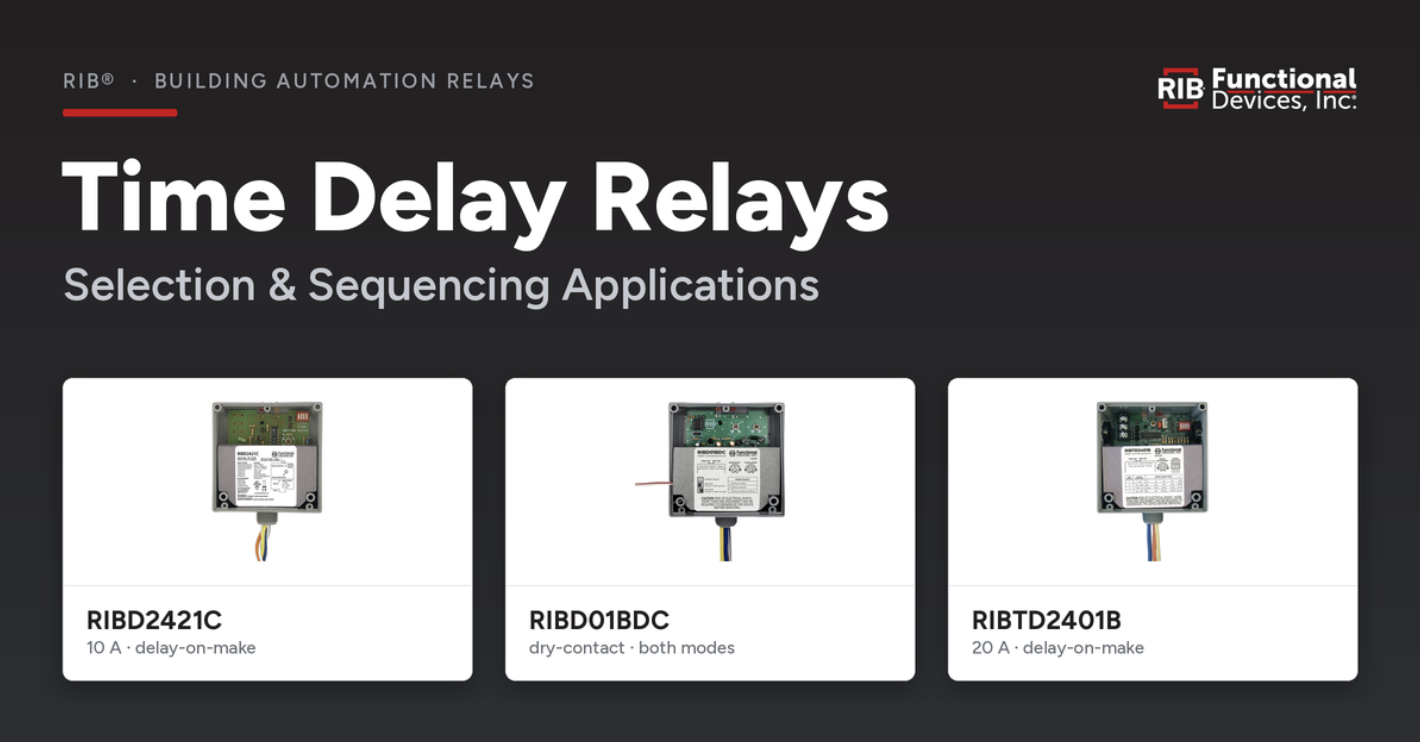
A time delay relay is used to stage equipment on and off in sequence instead of all at once. The timing is designed into the equipment: for example, a fan waits for a damper to open, a compressor stages behind the first one, a fan keeps running after the burner shuts off. Functional Devices, Inc. builds a line of RIB® (Relay-In-a-Box®) time delay relays for these types of jobs.

Two Timing Functions: Delay-on-Make and Delay-on-Break
A time delay relay works one of two ways.
A delay-on-make relay waits for a set time after the signal arrives, then switches the load.
A delay-on-break relay switches the load when the signal arrives, then holds it for a set time after the signal drops.
Some jobs need both: a delay when the signal arrives and a delay when the signal drops. In those cases, one relay can cover both timing functions instead of requiring separate devices for turn-on and turn-off sequencing. That is useful when a piece of equipment has to wait before starting, then continue running for a set period after the control signal is removed. A relay such as the RIBD01BDC can be set for delay-on-make, delay-on-break, or both, which gives the control sequence more flexibility without complicating the parts list.
Selecting a Time Delay Relay for the Equipment
Four factors determine the correct model for a specific application: the timing function, how the relay is triggered, the timing range, and the load.
Timing Function
For delay-on-make, the RIBTD2401B (20 Amp) and the smaller RIBD2421C (10 Amp) delay a load after the coil energizes. For both modes in one, the RIBD01BDC switches between delay-on-make, delay-on-break, or both.
Trigger
The RIBTD2401B and RIBD2421C are driven by a coil voltage: 24 Vac/dc or 120 Vac on the RIBTD2401B, 24 Vac/dc or 120–277 Vac on the RIBD2421C. The RIBD01BDC and RIBD02BDC take a Class 2 dry-contact input instead, so the equipment’s controller starts the timing with a voltage-free contact closure.
Timing Range
The coil-driven relays cover 6 seconds to 20 minutes, set on a DIP switch. That range fits the short delays commonly used to stage equipment, such as holding a fan off until a damper opens or bringing on a second load after the first one has started. Because the setting is made directly on the relay, the installer can match the timing to the sequence the equipment requires.
The dry-contact RIBD01BDC and RIBD02BDC cover 1–30 seconds or 1–30 minutes, set with a jumper. That gives the controller a choice of short-cycle or longer run-on timing while using a Class 2 dry-contact trigger. In practice, that means the same relay family can handle quick staggered starts, brief off-delays, or longer post-run periods, depending on the sequence.
Load and Power
The 10 Amp RIBD2421C handles pilot and light loads; the 20 Amp RIBTD2401B, RIBD01BDC, and RIBD02BDC handle larger loads, including pilot duty to a contactor coil. Match the power input to the equipment: the RIBD01BDC runs on 120 Vac, the RIBD02BDC on 208–277 Vac.

Sequencing With a Time Delay Relay
The timing usually coordinates two loads.
Delay-on-make handles a load that has to start after another. A circulating fan can start a few seconds after its heater, or a second compressor can stage behind the first so the equipment does not draw both inrush currents at once. The RIBTD2401B delays the load after its trigger arrives.
Delay-on-break handles a load that has to keep running after its signal drops. A fan can purge residual heat after the burner stops, or a pump can run on after a call ends. The RIBD01BDC, set to delay-on-break, holds the load for the delay after the signal is removed.
Frequently Asked Questions About Time Delay Relays
What is the difference between delay-on-make and delay-on-break?
Delay-on-make waits a set time after the signal arrives, then switches the load, which stages a load behind another. Delay-on-break switches the load when the signal arrives and holds it for a set time after the signal drops, which keeps a load running past its trigger.
Which Functional Devices time delay relays are coil-driven?
The RIBTD2401B (20 Amp, 24 Vac/dc or 120 Vac coil) and the RIBD2421C (10 Amp, 24 Vac/dc or 120–277 Vac coil). Both are delay-on-make and set from 6 seconds to 20 minutes.
Which model takes a dry-contact input?
The RIBD01BDC (120 Vac power) and RIBD02BDC (208–277 Vac power). A Class 2 dry contact from the equipment’s controller starts the timing, and both switch between delay-on-make, delay-on-break, or both, from 1–30 seconds or 1–30 minutes.
What timing range do the relays cover?
The coil-driven RIBTD2401B and RIBD2421C run 6 seconds to 20 minutes. The dry-contact RIBD01BDC and RIBD02BDC run 1–30 seconds or 1–30 minutes.

Source Time Delay Relays
Browse the full RIB® relay product line, or use our Functional Devices distributor locator to find an authorized distributor near you.