
Data centers are engineered around a single, unforgiving metric: uptime. When availability targets push toward 99.982 percent or higher—roughly Tier III performance—every supporting system must perform predictably, continuously, and without drift. Power distribution, control, and monitoring are foundational to that mandate. Relays and current sensors, though often small in footprint, play an outsized role in protecting critical loads and maintaining operational continuity. Become a Regional Distributor Today.

This article examines how purpose-built relays and current sensors from Functional Devices support data center reliability goals by improving control integrity, simplifying installation, and enabling actionable monitoring across power and mechanical systems.
Frequently Asked Questions
What makes data center relays different from standard control relays?
Data center relays are selected for higher reliability, better isolation, and compatibility with mission-critical control systems. They are often enclosed, conservatively rated, and designed for continuous operation.
How do current sensors improve preventive maintenance?
By monitoring amperage trends, sensors can identify abnormal load conditions, failing motors, or stuck dampers before they trigger alarms or shutdowns.
Are Functional Devices products compatible with DCIM platforms?
Yes. Functional Devices relays and sensors provide industry-standard outputs that integrate with most BAS and DCIM systems used in data centers.
Can these components be retrofitted into existing facilities?
Many models are designed specifically for retrofit applications, including split-core sensors and enclosed relays that minimize downtime during installation.
Why Do Relays Matter in High-Availability Data Centers?
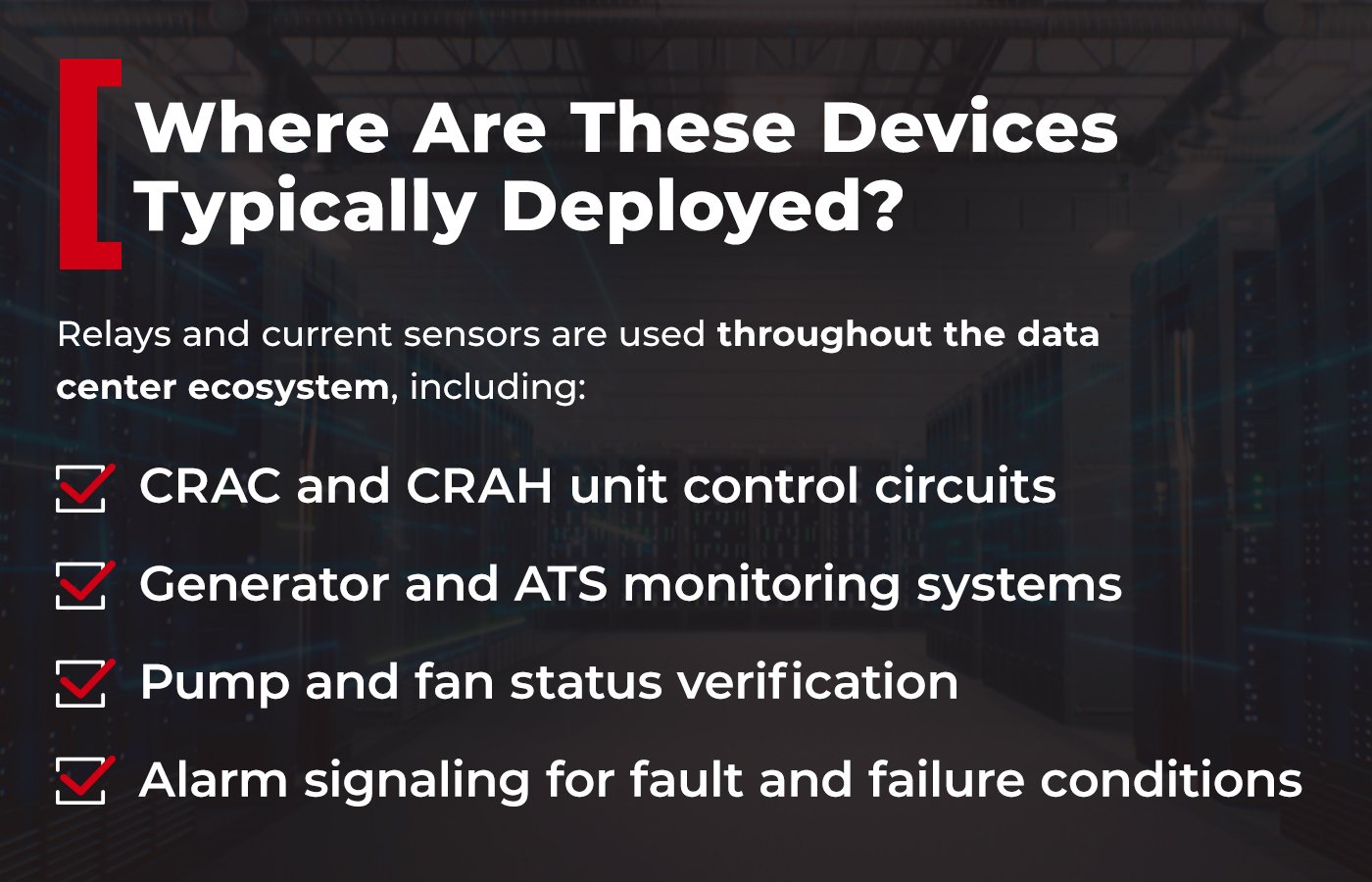
Relays act as the interface between low-voltage control logic and higher-voltage loads—fans, pumps, dampers, contactors, alarms, and backup systems. In data centers, these devices are not optional conveniences; they are safety and reliability components.
Functional Devices relays are designed with control system isolation in mind, protecting sensitive BAS and DCIM controllers from voltage transients and load-side faults. Models such as the RIB® enclosed relay family offer:
- 10–20 A contact ratings for pilot duty and general-purpose loads
- Wide coil voltage options (24 VAC/VDC common in data center environments)
- UL Listed and RoHS compliant construction
- Enclosed housings that reduce installation errors and contamination risk
How Do Current Sensors Support Uptime and Risk Mitigation?
Monitoring is the second pillar of reliability. Data centers rely on accurate, real-time feedback to identify abnormal conditions before they escalate into failures. Current sensors can convert physical conditions into data that control systems can act on immediately.
Functional Devices current sensors are engineered for continuous-duty applications and are commonly used to monitor electrical current flow on critical feeders and branch circuits.
Current sensors enable load verification without interrupting conductors. Split-core designs simplify retrofits and expansions, while solid-core models deliver long-term accuracy for permanent installations. Typical specifications include:
- Measurement ranges from fractional amps to hundreds of amps
- Linear or switched outputs compatible with BAS and DCIM platforms
- High dielectric strength and long insulation life
Learn more about Functional Devices current sensors.

What Reliability Benchmarks Should Power Components Meet?
Data center infrastructure is often designed to Tier III or Tier IV standards, targeting 99.982 percent to 99.995 percent uptime—no more than minutes of unplanned downtime annually. Supporting components must align with these expectations.
Functional Devices products are built for industrial and commercial environments where long service life is assumed, not optional. Reliability-focused design choices include:
- Conservative electrical ratings to prevent thermal stress
- Mechanical designs tested for millions of switching cycles
- Encapsulated electronics that resist dust, vibration, and humidity
These characteristics help ensure that control components remain stable over the same lifecycle as UPS systems, generators, and cooling equipment.
How Do Relays and Current Sensors Simplify System Expansion?
Scalability is a constant in data centers. As racks are added and loads shift, control systems must adapt without introducing risk.
Functional Devices supports this flexibility through standardized form factors and clear wiring schemes. Many relays are pre-wired in NEMA-style enclosures with color-coded leads, reducing installation time and minimizing technician error. Current sensors with tool-free mounting and clear labeling speed commissioning and future modifications.
The result is faster deployment with fewer opportunities for miswiring—an important consideration when changes occur in live environments.
How Does Procurement Affect Reliability?
Component quality is only part of the equation. Consistent sourcing ensures that replacements and expansions match original specifications. Functional Devices works through an established distributor network to provide reliable availability and technical support. Finding an authorized distributor helps ensure correct product selection and fast delivery when schedules are tight.
Find a Functional Devices distributor here.
What certifications should these components carry?
UL Listing, RoHS compliance, and adherence to applicable electrical standards are essential for components used in critical infrastructure environments.
Building Resilience into the Control Layer
Data center reliability is built from the ground up, and control components deserve the same scrutiny as larger infrastructure investments. Relays and current sensors from Functional Devices provide dependable switching, accurate monitoring, and long service life—supporting uptime targets measured in minutes per year, not hours.
For engineers and operators tasked with protecting critical loads, smart power starts with proven components and trusted distribution partners. Locate an authorized distributor to specify the right relays and current sensors for your next data center project.