On a multi-building or multi-panel job, relay count is where both the parts list and the callback list can really grow. Every control point that needs a different coil voltage or a different switching sense is another relay to stock, spec, and wire.
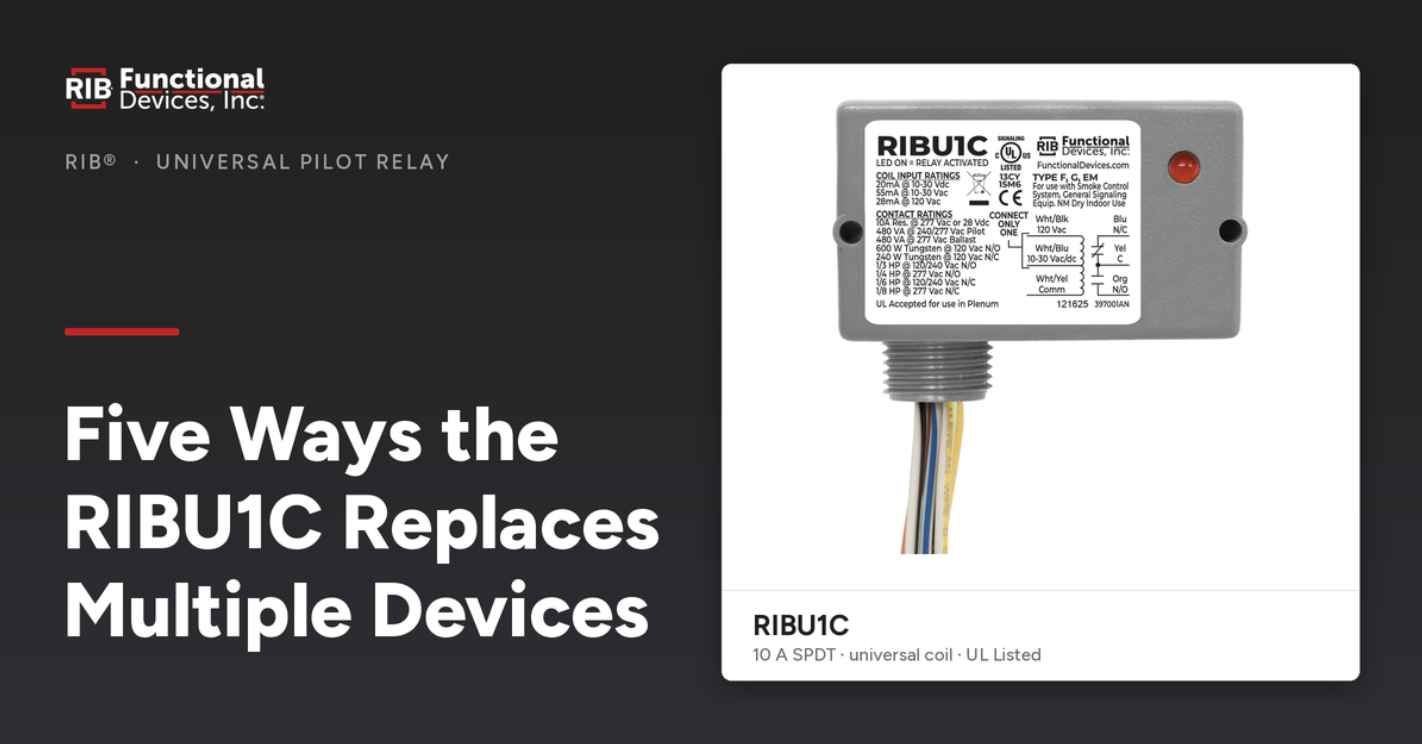
Functional Devices, Inc. builds the RIBU1C—a pre-wired, UL Listed RIB® (Relay-In-a-Box®) device—in the United States. The RIBU1C is able to do the work of several different parts on a controls job because of its simplicity, its durability, its diverse switching capabilities, and its compatibility with multiple power sources.
Read on to learn the five main ways that integrators use the RIBU1C to simplify building automation jobs.

1. Interposing Between a Controller and a Line-Voltage Load
The RIBU1C’s base use is isolation. Because a building automation system (BAS) or programmable controller output switches at low voltage and cannot drive a line-voltage load directly, the RIBU1C sits between them—its coil takes the control signal, its contacts switch the load—so the controller never comes into direct contact with line voltage. One relay can be used for fan coils, small lighting loads, and solenoid valves, up to its 10 Amp rating. For applications above 10 Amps, use the RIB2401B (20 Amp SPDT) instead.
2. Piloting a Contactor or Power Relay
When a load is larger than a pilot relay is able to switch—a large motor, for example, a bank of lighting, or a heater—it should be switched by a contactor, not by the RIBU1C directly. A contactor closes its heavy power contacts and switches a load when its own coil is energized. However, a building automation controller output usually cannot energize it directly: the coil often runs at a higher voltage than the controller can supply, and the current surge it draws can wear out a small controller output over repeated cycles.
This is where the RIBU1C becomes relevant. The controller drives the RIBU1C coil; the RIBU1C contacts, isolated from that coil and rated for the inrush, energize the contactor coil; the contactor switches the load. The controller only ever drives the small relay, and one RIBU1C bridges any control voltage to any contactor-coil voltage.
This is also the correct approach for motor loads. The relay handles on-and-off switching, while overload protection stays with the starter or the motor’s thermal protector. A RIB relay does not protect a motor from overload.
3. Covering Normally-Open or Normally-Closed Logic With One Relay
The RIBU1C’s SPDT contacts include both normally-open and normally-closed outputs, so one relay can cover either switching direction depending on how it’s wired. An integrator does not need to stock a separate N/O and N/C part; one RIBU1C covers both. Its dry contacts also switch high voltage, low voltage, or a dry signal, so the same relay works whether the downstream device is a line-voltage load or a low-voltage input on another controller.
4. Standardizing on One RIBU1C Coil Across the Job
The RIBU1C coil accepts 10-30 Vac/dc or 120 Vac, so one part works whether a given controller outputs 24 Vac, 24 Vdc, or line voltage. On a job with mixed controllers, that means the RIBU1C can replace the two or three voltage-specific relays an integrator would otherwise stock.
5. Replacing a Loose Relay Assembly With One RIBU1C
Specified as discrete parts, a single control point is a relay, a socket, a mounting base, surge suppression, and an enclosure: five separate items to order, assemble, and mount. The RIBU1C is all of that in one pre-wired device. Across a job with dozens of control points, that removes most of the panel assembly a loose-relay approach would require.

Frequently Asked Questions About RIBU1C Applications
What is a RIBU1C used for?
The RIBU1C is a 10 Amp SPDT pilot relay that isolates a low-voltage controller output from a line-voltage load, pilots a contactor, or covers normally-open or normally-closed logic. One part covers most of the control points on a building automation job.
Can one RIBU1C replace relays of different coil voltages?
Yes. Its universal coil accepts 10-30 Vac/dc or 120 Vac, so one RIBU1C covers control points that would otherwise need separate 24 Vac, 24 Vdc, and 120 Vac relays.
What if the load is more than 10 amps?
Step up to the RIB2401B (20 Amp SPDT) for a larger load, or use the RIBU1C to pilot a contactor sized to the load.
Can a RIBU1C prove a load is running?
A standard RIBU1C switches a load but does not report whether it is running. To confirm a load is drawing current, use a current sensor such as the RIBXGTA.

See What One RIBU1C Can Replace on Your Next Job
Interested in the RIBU1C? Explore the RIBU1C product page and datasheet, browse the full RIB® relay line, or find an authorized Functional Devices distributor near you.