
A common question we get from contractors and panel builder customers is: which do I need, a relay or a contactor? For your counter staff, understanding the answer to this question is what builds the kind of technical trust that brings customers back. This guide gives you the application logic to answer that question confidently, and positions Functional Devices RIB® relays as the right call across the wide range of switching applications where they belong.

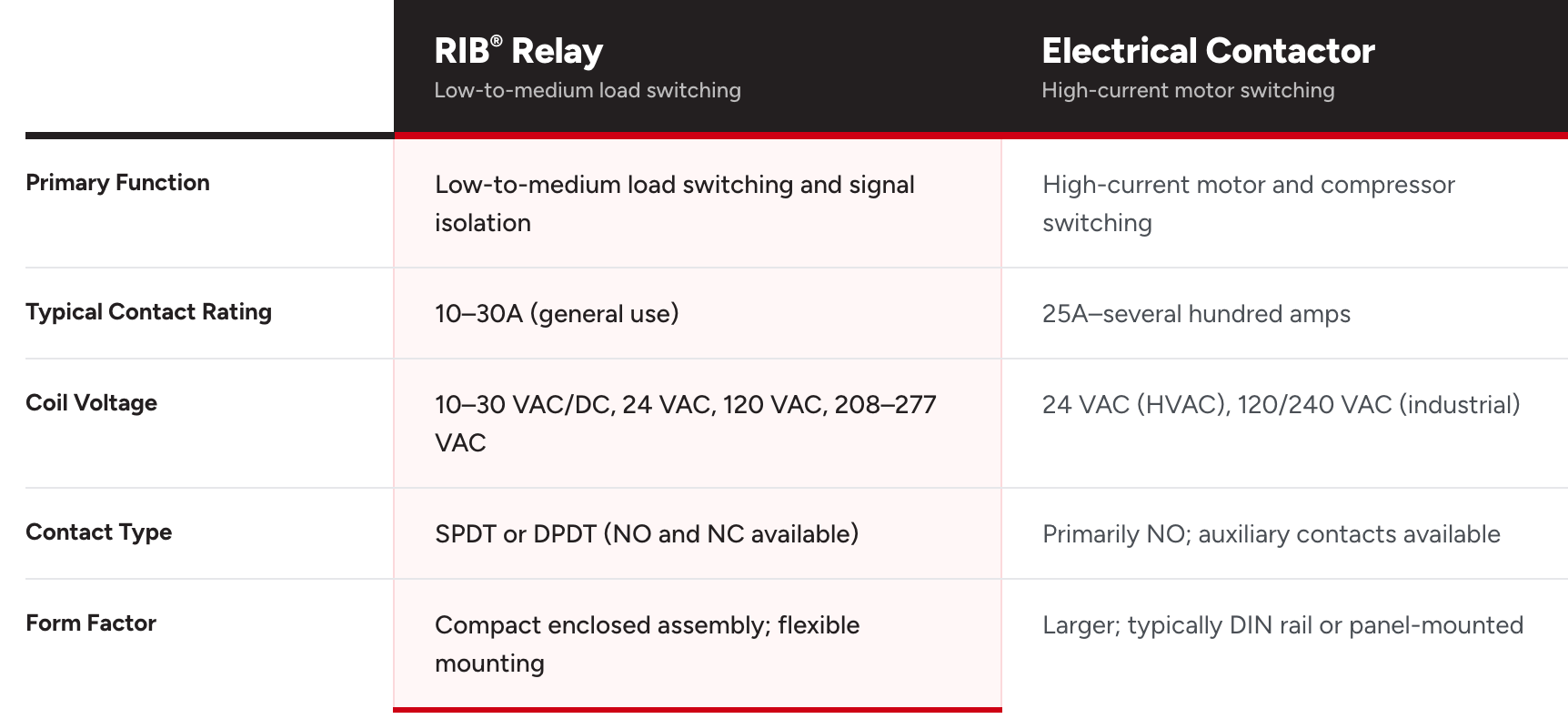
Key Differences: Load Capacity, Coil, and Application
Find the Right Device for the Job
Relays and contactors both have an essential place in HVAC and BAS installations. For low-voltage signal switching, BAS output isolation, fan coil control, and lighting applications, a RIB® relay from Functional Devices is the right call: faster to install, easier to source, and purpose-built for the loads you're switching. For compressors, large motors, and high-inrush inductive loads, a properly rated contactor is what the application requires.
When you're ready to specify, browse the full RIB® relay lineup or find an authorized Functional Devices distributor near you.

When to Use a Relay in HVAC and BAS?
A relay is the right choice when you need to interface a low-voltage control signal with a load that requires switching. In HVAC and BAS work, that covers a very wide range of applications.
BAS Controller Outputs
BAS controllers output binary signals to switch equipment: fans, valves, dampers, lighting. Those outputs are typically 24VAC or a dry contact. A RIB® relay translates that signal into a switched circuit, keeping the controller isolated from line voltage. This is the core BAS relay application.
Fan Coil Unit Control
A thermostat or BAS output sends a 24VAC signal to the relay coil; the relay contacts switch line voltage to the fan motor. The RIB2401B is a common choice here—a 20A SPDT relay with 24VAC coil that handles this scenario cleanly across a wide range of fan coil configurations.
Damper and Actuator Switching
Spring-return damper actuators draw modest current when energized. A RIB® relay handles this load comfortably and provides the electrical isolation that protects the controller output.
Lighting Control
RIB® relays are commonly used for scheduled or occupancy-based lighting switching via a BAS or panel controller. Models with appropriate contact ratings handle LED and fluorescent fixture loads, including banks of fixtures on a single circuit.
Make-Up Air and Exhaust Fan Control
For single-phase fan motors up to the relay's horse power (HP) rating, a RIB® relay is a straightforward and code-compliant solution. Check horse power (HP) ratings on the datasheet when the load is a motor.
Thermostat-to-Equipment Bridging
A thermostat sends a 24VAC signal to call for heating or cooling, but the equipment requires line voltage to operate. A relay like the RIB2401B bridges that gap, drawing only 83mA from the thermostat output while switching a 1HP 120VAC motor load.

When a Contactor Is the Right Choice
A contactor belongs in the circuit when the load is a motor, compressor, or other high-inrush inductive device that exceeds what a general-purpose relay is rated to handle safely and repeatedly.
Compressors
Residential and light commercial HVAC compressors are almost universally switched by contactors. The startup inrush current on a compressor—often 6–8 times the running current—requires a device rated for that duty. A general-purpose relay is not.
Chiller and Rooftop Unit Compressor Staging
Larger tonnage equipment with multiple compressors uses contactors at each stage. The contact ratings, arc suppression, and mechanical durability are all sized for the application.
Electric Heat Strips
Resistance heating elements can draw high steady-state current. Contactors are standard in electric furnace and heat pump auxiliary heat applications.
High-Cycle Applications
If the device switches a motor load thousands of times per day, a contactor's heavy-duty contacts and arc suppression may be better suited for that duty cycle. A relay contact can wear prematurely in the same application.
One important nuance: some RIB® relay models carry a pilot duty rating, which means they are rated for inductive load control applications within that rating. Always check the datasheet for the general-use contact rating, any published pilot duty rating, and horse power (HP) rating before specifying a relay for those types of loads. If the load exceeds any of those ratings, a contactor may be required.
A Note on Overload Relays and Definite Purpose Contactors
Two terms that come up frequently in spec documents and customer questions are overload relays and definite purpose contactors. An overload relay is a protective device; it monitors current draw and trips the circuit if a motor pulls more than its rated amperage.
It is not a switching device in the same sense as a RIB® relay, and the two are not interchangeable. A definite purpose contactor is a contactor designed for a specific application category—most commonly HVAC compressor duty—and carries ratings suited for that load type. When a spec calls for either of these devices, verify the load requirements before substituting a general-purpose relay. If the application falls within RIB® relay contact and pilot duty ratings, a substitution may be appropriate; if it does not, it is not.
Frequently Asked Questions
What is the main difference between a relay and a contactor?
The main differences are load capacity and intended application. Relays are designed for low-to-medium current loads and control signal switching, with typical contact ratings up to 20–30A. Contactors are designed for high-current motor and compressor loads, with ratings from 25A up to several hundred amps and heavy-duty arc suppression built in for inductive load switching.
Do distributors need to stock both relays and contactors?
Yes, because they serve fundamentally different load categories and your customers will need both depending on the job. RIB® relays cover the majority of BAS output switching, fan coil control, lighting, damper actuation, and thermostat-bridging applications your HVAC and controls contractors encounter. Contactors are required when the load is a compressor, large motor, or high-inrush inductive device that exceeds relay ratings. Stocking both ensures your branch can fulfill spec orders completely without sending a contractor to a second supplier.
Can I use a RIB® relay instead of a contactor?
For loads within the relay's contact and pilot duty ratings, yes. For compressors, large motors, 3-phase loads, or any high-inrush inductive load that exceeds the relay's rated capacity, no—a contactor is required. Using a relay for a load it isn't rated for will cause premature contact wear and eventual failure.
What is a pilot duty rating on a relay?
Pilot duty is a contact rating that indicates the relay is suitable for switching inductive loads within that rating. It accounts for the inrush current which occurs at startup, which can be several times the running current. Always verify the pilot duty rating on the datasheet before using a relay to switch an inductive load.
Are RIB® relays UL Listed?
Yes. Enclosed RIB® relay models are UL Listed as complete, field-ready assemblies. Always verify the specific listing standard on the product datasheet for your application.
Can I use a contactor where a relay would work?
Technically, yes—but a contactor is typically larger, more expensive, and overkill for low-current control and switching applications. For BAS output switching, fan coil control, and similar applications, a compact UL Listed RIB® relay is the appropriate and cost-effective choice.