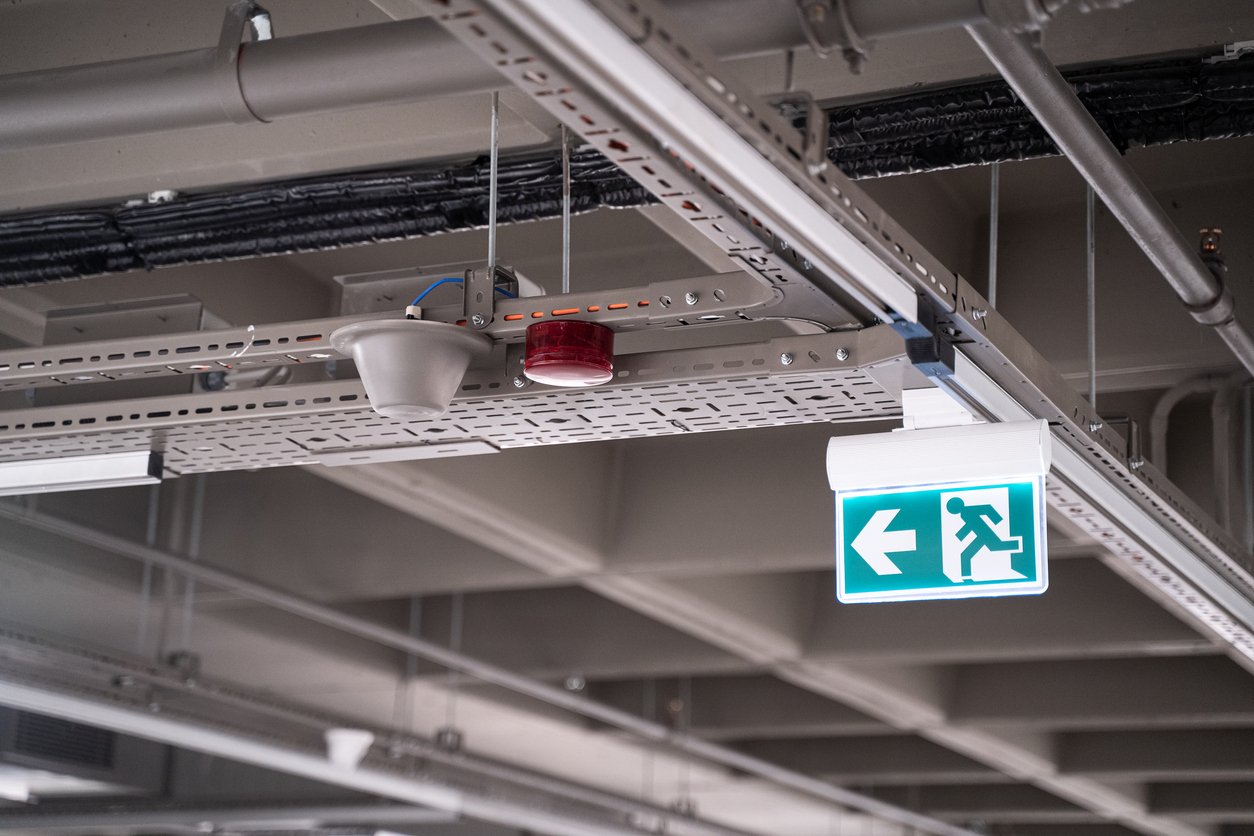
Texas commercial buildings—offices, schools, hospitals, retail centers, and industrial facilities—are required to maintain emergency egress lighting during power outages. For electrical contractors working on Texas commercial projects, understanding which relay device is appropriate for emergency lighting control is both a code compliance issue and an inspection issue.

How NEC Article 700 Addresses Emergency Lighting Control Relays
NEC Article 700 governs emergency systems in commercial buildings. Under section 700.26, if an emergency lighting load needs to be automatically energized upon loss of normal power, a listed Automatic Load Control Relay (ALCR) is a permitted means of doing so. The code language is permissive, not prescriptive. A UL1008-listed Branch Circuit Emergency Lighting Transfer Switch (BCELTS) is the other NEC-recognized device for branch circuit applications, used when the design requires transferring the load between a normal and emergency source rather than bypassing a control.
For the majority of Texas commercial applications—where the goal is bypassing a wall switch, dimmer, occupancy sensor, or lighting control panel relay to force an emergency fixture on during a power outage—an ALCR listed to UL924 is the appropriate and most commonly specified device.
UL924 vs. UL1008: Which Applies to Your Texas Project?
The distinction comes down to function. A UL924-listed ALCR is designed to force an emergency fixture on when normal power is lost—the right tool when your emergency lighting needs to be controlled with surrounding Normal lighting. A UL1008-listed BCELTS is designed to transfer a branch circuit load from a normal power source to an emergency source—the right tool when the design requires a source transfer rather than a control bypass.
For most Texas commercial retrofit and new construction projects involving occupancy sensors, dimmers, or panel-based lighting controls on emergency egress circuits, UL924 is the applicable listing. When in doubt, consult the specifying engineer and your AHJ.
When a UL924 ALCR Is the Right Device
A UL924 ALCR is the right choice whenever an emergency lighting fixture needs to be turned on and off or dimmed with the surrounding Normal lighting. The ALCR ignores the Normal lighting control automatically when normal power is lost, forcing the emergency fixture on regardless of the switch or control state.
Texas commercial projects where UL924 ALCRs are commonly specified include:
- Office buildings with dimming or occupancy-based lighting controls on corridors and stairwells
- Schools where classroom lighting controls must be bypassed during fire or power events
- Healthcare facilities with complex lighting control systems in corridors and patient areas
- Retail and hospitality spaces where emergency egress lighting is integrated with decorative or scheduled lighting systems
For Texas contractors also working on broader BAS retrofit projects that include emergency lighting controls, see BAS Retrofits in Texas for related hardware considerations.
Functional Devices UL924 Emergency Lighting Relays
Functional Devices, Inc. offers UL924-listed ALCRs specifically for emergency lighting applications. The ESRN is the flagship model for full ALCR applications. When normal power is present, the lighting load can be switched normally with the surrounding Normal lights; when normal power drops out, the emergency fixture is forced on, regardless of the Normal wall switch or control state. The ESRN includes built-in test capability to support NEC 700.4 and NFPA 101 testing requirements.
For applications requiring a simpler shunt or bypass approach rather than a full ALCR, Functional Devices also offers UL924-listed shunt/bypass models including the ESR2402B and ESR2401B.
For Texas electrical contractors sourcing UL924 emergency lighting relays locally, find an authorized Functional Devices distributor in Texas.