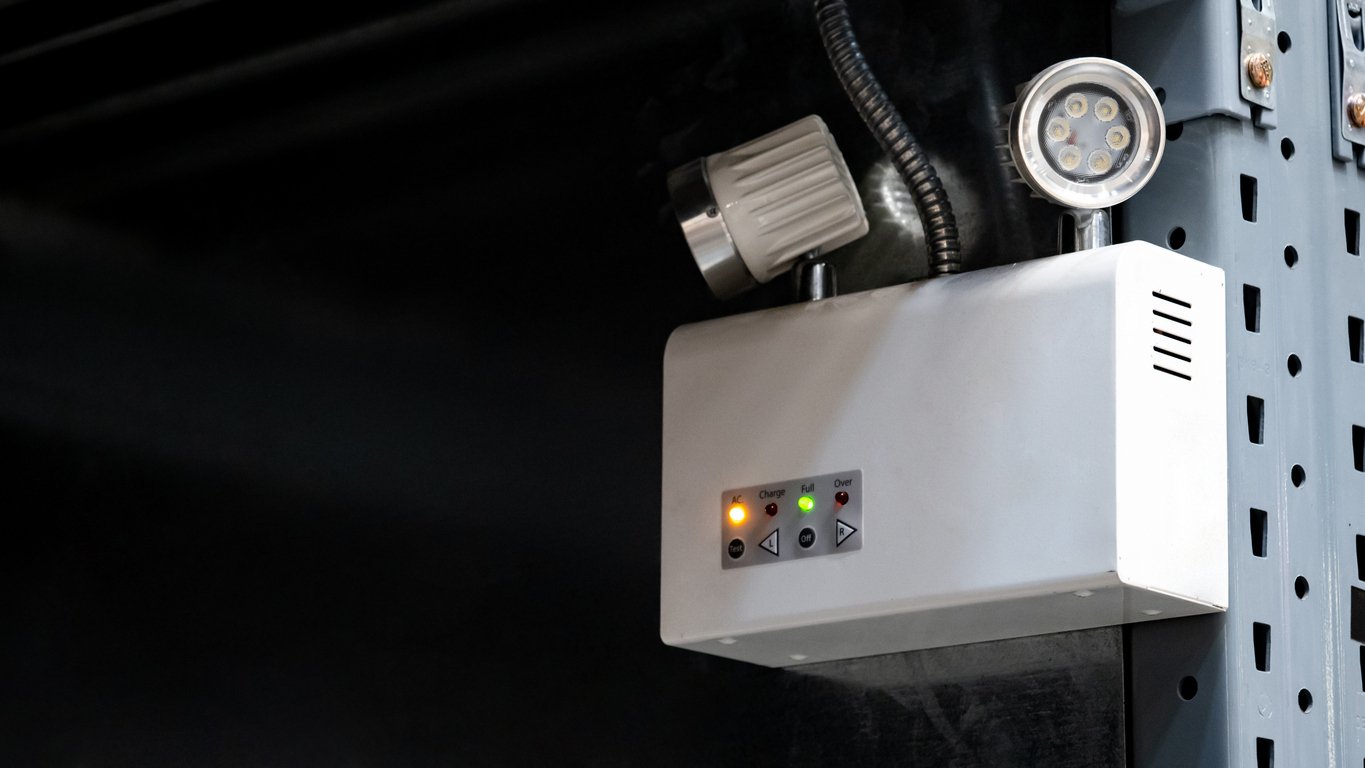
When normal power fails, properly designed emergency egress lighting systems guide occupants to safety, reduce liability, and help buildings meet strict code requirements. For electrical contractors, engineers, and lighting reps, understanding the difference between UL 924 and UL 1008 is essential to getting these systems right.
What Is Emergency Lighting Control?
Emergency lighting control ensures that designated lighting circuits automatically illuminate when normal power is lost. These systems are required in commercial, industrial, healthcare, and educational facilities—anywhere safe evacuation depends on reliable illumination.
At a basic level, emergency lighting systems detect the loss of normal power, transfer or energize emergency circuits, and override local controls like switches, dimmers, and sensors. That last function is where many installations get complicated—and where UL 924 devices play a critical role.
Understanding UL 924
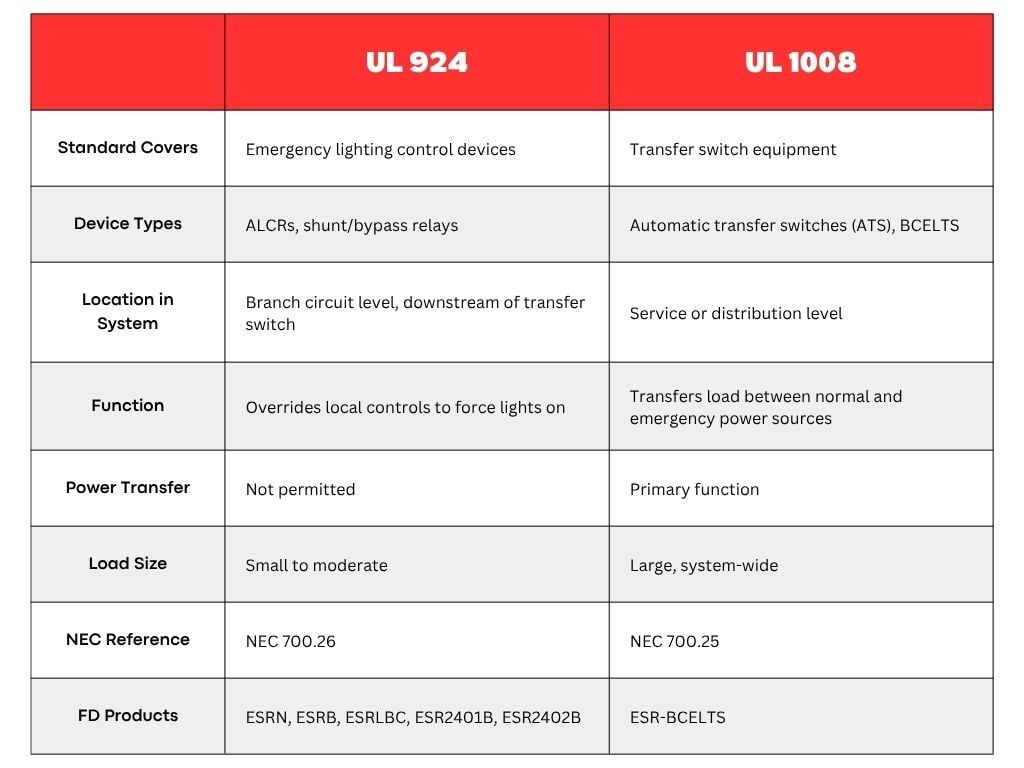
UL 924 is the standard for Emergency Lighting and Power Equipment. It governs devices used to control emergency lighting loads—specifically, devices that ensure lights turn on at full brightness during a power loss, regardless of the state of local controls.
UL 924 devices require a normally-on power source and are typically installed downstream of a transfer switch. They are not permitted by code to transfer power between sources—that’s a separate function covered by UL 1008.
The Two Main Types of UL 924 Devices
Automatic Load Control Relays (ALCRs) are the more full-featured option. When normal power is present, the relay coil is activated and the lighting load operates normally, controlled by wall switches, occupancy sensors, or dimming systems. When normal power drops out, the relay coil de-energizes, the normally-closed contact closes, and the lighting load is forced on at full brightness regardless of any local controls.
Functional Devices' ESRN is a widely used ALCR that accepts universal 120–277V inputs, supports 0–10V dimming override, and can be integrated with fire alarm panels via dry contact.
Shunt/Bypass Relays are a simpler, more compact option for applications that don't require full ALCR functionality. A shunt relay overrides a local wall switch, while a bypass relay overrides a lighting control panel circuit—both ensuring emergency lights turn on during a power loss. When normal power is present, the relay coil is activated and the local control operates as usual. When power drops, the coil de-energizes and the normally-closed contact closes, illuminating the load. Functional Devices' ESR2401B (120V) and ESR2402B (277V) are compact shunt/bypass options with 20A contact ratings and full UL 924 compliance—straightforward, cost-effective choices when a full ALCR isn't required.
Typical UL 924 Applications
UL 924 devices are commonly specified in office buildings with occupancy-based lighting, schools and universities with centralized lighting controls, hospitals and healthcare facilities, and retail environments with energy-saving lighting systems. In each case, they're installed at the branch circuit level to provide localized, code-compliant control.
Explore Functional Devices' full lineup of UL 924 emergency lighting relays.
Understanding UL 1008
UL 1008 covers transfer switch equipment, or devices that switch entire loads between power sources. Where UL 924 devices operate at the branch circuit level and control how lights behave, UL 1008 equipment operates upstream, managing where power comes from.
UL 1008 transfer switches handle the transition between normal utility power and emergency sources like generators or inverters, manage high current loads, and serve as central switching equipment for entire buildings or systems. Functional Devices manufactures a Branch Circuit Emergency Lighting Transfer Switch (BCELTS)—the ESR-BCELTS—which is designed to automatically transfer a lighting load from a normal source to an emergency source upon power loss, and can also override 2, 3, or 4-wire dimming controls and bypass switches in the same installation.
Typical UL 1008 Applications
UL 1008 equipment is commonly found in hospitals with backup generators, data centers, large commercial buildings, and industrial facilities where entire systems need to transfer to emergency power.
UL 924 vs. UL 1008: Key Differences
In many buildings, both standards work together—a UL 1008 transfer switch brings generator power online while UL 924 relays ensure individual lighting zones respond correctly. Here's how they compare:
Why UL 924 Relays Matter More Than Ever
Modern buildings are designed for energy efficiency. Lighting systems are no longer simple on/off circuits; they're integrated with occupancy sensors, daylight harvesting controls, dimmers, and building automation platforms. That complexity creates a real problem: during a power outage, those same controls can prevent lights from turning on when they're needed most.
UL 924 relays solve that problem by providing a fail-safe override that operates independently of whatever control scheme is in place. They're also straightforward to specify and install. Functional Devices' ESR series relays come pre-wired with clearly labeled terminals, making installation faster and reducing the chance of field errors.
Common Emergency Lighting Control Configurations
Normal/Emergency Circuit Separation
A dedicated emergency circuit feeds selected fixtures. A UL 924 relay ensures those fixtures turn on, regardless of local controls.
Shared Circuit with Control Override
Fixtures operate normally under sensors, switches, or dimmers but are forced on during an outage using a UL 924 relay. The ESRN and ESR2401B/ESR2402B are both well-suited for this configuration.
Generator-Backed Systems
A UL 1008 transfer switch brings generator power online, while UL 924 relays manage lighting behavior at the branch circuit level. Both standards are typically present in this configuration.
Installation Considerations
A few factors are worth confirming upfront when specifying UL 924 relays. Coil voltage should match your control circuit—the ESR2401B is rated for 120V applications and the ESR2402B for 277V. Load compatibility with LED drivers should be verified for the specific model being specified.
Mounting environment matters, too. Enclosed, ballast-channel, and slim-profile options are available depending on the installation. As always, verify local and national code requirements before finalizing any design.

Frequently Asked Questions
What is the main purpose of a UL 924 relay?
A UL 924 relay ensures that emergency lighting turns on during a power loss by overriding normal lighting controls, like switches, dimmers, occupancy sensors, or BAS inputs.
What's the difference between a shunt relay and an ALCR?
A shunt or bypass relay is a simpler device that overrides a local switch or control panel circuit. An ALCR (Automatic Load Control Relay) provides more comprehensive control, allowing normal operation of the lighting circuit while guaranteeing emergency override when power is lost.
Do I need UL 924 if I already have a generator?
Yes. A generator (via UL 1008 equipment) supplies power, but UL 924 relays ensure the lights actually turn on and bypass any control systems that might otherwise keep them off.
Can UL 924 relays be used with LED lighting and dimming systems?
Yes, but compatibility with specific LED drivers and dimming systems should be confirmed for the model being specified. Functional Devices' ESRN and ESRLBC both support 0–10V dimming override.
Where are UL 924 relays typically installed?
At the branch circuit level, downstream of any transfer switch—near lighting panels, within junction boxes, or inside fixture ballast channels depending on the model.
What happens if I don't use a UL 924 relay?
Without proper control override, energy-efficient lighting systems may fail to illuminate during an outage, resulting in code violations and potential safety hazards.

Powering Safety with the Right Components
Emergency lighting control is a critical layer of building safety. Understanding the difference between UL 924 and UL 1008 helps ensure systems are designed correctly from the ground up, with the right device at each level of the system.
Functional Devices manufactures both UL 924-compliant ALCRs and shunt/bypass relays and UL 1008-compliant transfer switches, making it easier to source a complete, code-ready solution from a single trusted manufacturer.
To learn more or get help selecting the right product for your application, contact Functional Devices at (800) 888-5538 or use our online contact form.
Looking for a local supplier? Use our Find a Distributor tool.