For our Lighting Reps: Read This First
When a school or apartment parking lot job comes across your desk, it has usually gone one of two ways: no quote — contractor provided — or an attempt to switch the customer to a relay panel. Both are costing you jobs. There is now a third option that fits the application.
Parking lot lighting needs one thing: dependable ON at dusk, OFF at dawn, with a few zones that shut down later in the evening. Letting it go contractor-provided hands off a product decision you should own. Switching to a relay panel goes the other direction: extensive field wiring, software commissioning, and specialized training the on-site maintenance staff will never have. You over-specify past the original intent of the electrical spec, drive up labor and cost, and hand a competitor the opening.
The LCC Series does not replace relay panels — it complements them. Relay panels belong on large, complex facilities that need zoning, 0-10V dimming, individual ballast control, and centralized management. The LCC Series is the right-sized answer for standalone, straightforward zones running ON/OFF scheduling, photocell, or timer control. A parking lot is the second case, every time.
Lead with what the customer gets:
- It arrives ready to mount. Factory-assembled, tested, and lockable — no sourcing and wiring separate contactors, timers, and enclosures on a wall in the field. That is the labor number that moves the bid.
- It never needs a seasonal adjustment. The astronomic 7-day/365-day clock calculates sunrise and sunset by geographic zone, with DST auto-adjust, custom offsets, up to 96 set points, and up to 50 holiday and exception periods.
- It never needs a battery. A 100-hour supercapacitor holds the schedule through extended outages and recharges automatically — no more service calls for a dead coin cell after a storm.
- Maintenance can work at night without leaving lights on. A Hand-Off-Auto switch gives manual control, and the built-in 2-hour override turns manual ON into a timed override.
- It mounts where site lighting panels actually live. Lockable NEMA 3R protects against dust, rain, and ice — indoors or outdoors near a parking structure.
- Dusk-to-dawn is included, and BMS is a wire away. Every unit ships with an exterior photocell (zero-crossing, 255J MOV surge protection) plus a dry contact input for a BMS or remote switch.
- One schedule covers the whole campus or portfolio. Program one cabinet, save it to USB, and load every other cabinet in seconds — the strongest story you have with a district running multiple buildings or a management company running multiple properties.
And it is backed by a 10-year warranty — a credibility argument as much as a cost one on a property that has already replaced a failed time clock.
Sizing is Purely Pole Count
- LCC-4 (4-pole) — a single school building or small apartment community: main lot, building wall packs, walkways, entry and signage.
- LCC-8 (two 4-pole contactors) — a typical K-12 campus or mid-size garden community: staff and visitor lots, bus loop, carports, amenity or athletic areas.
- LCC-12 (three 4-pole contactors) — larger, phased, or multi-building campuses zoning parking, drop-off loops, perimeter, walkways, athletic and amenity areas, and signage.
All three share the same ratings: 40 Amp at 240–600 Vac resistive, 16A electronic ballast/LED at 120–277 Vac, 120 Vac 60 Hz control power, lockable NEMA 3R.
Collateral: LCC Series Flyer and the LCC-4, LCC-8, and LCC-12 product pages at functionaldevices.com.

Dusk-to-Dawn Control for School and Apartment Parking Lots
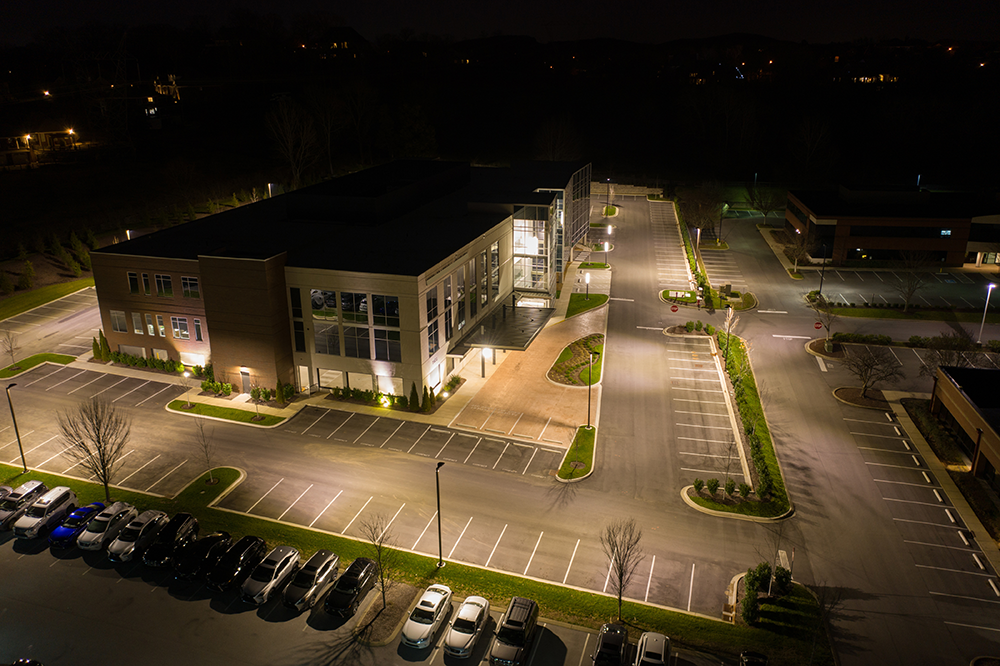
A dark parking lot is a problem in any building type, but it shows up fastest at a school and an apartment community. At a school, the lot has to be lit before the first staff car arrives and long after an evening game or board meeting lets out. At an apartment community, it is the first thing a prospective tenant notices on an evening tour and the first thing a property manager hears about after an incident. Both are also carrying exterior lighting as one of the largest recurring line items on the energy bill.
The control behind those lots, though, is usually assembled piece by piece in the field — a separate contactor, a separate timer, a separate enclosure, and a sensor mounted somewhere else on the site — or over-built into a networked panel nobody on staff knows how to reprogram.
The LCC Series Lighting Contactor Cabinets from Functional Devices close that gap. The LCC-4, LCC-8, and LCC-12 bring the contactor, the astronomic time clock, the exterior photocell, manual override, and supercapacitor backup together in a single factory-assembled, lockable enclosure that arrives integrated, tested, and ready to mount.
What a School Campus Needs
A dark parking lot is a problem in any building type, but it shows up fastest at a school and an apartment community. At a school, the lot has to be lit before the first staff car arrives and long after an evening game or board meeting lets out. At an apartment community, it is the first thing a prospective tenant notices on an evening tour and the first thing a property manager hears about after an incident. Both are also carrying exterior lighting as one of the largest recurring line items on the energy bill.
What an Apartment Community Needs
The load on a garden-style or mid-rise community is straightforward: pole lights over the parking field, wall packs on the buildings, carport and breezeway fixtures, accent lighting on the leasing office and monument sign. It needs reliable ON and OFF scheduling — not microprocessors, gateways, and communication buses that only add points of failure. Offsets let you pull the parking field on ahead of sunset and shut the clubhouse or pool circuit at a fixed hour once quiet hours begin. The 2-hour override covers a night paving crew or a fixture replacement without burning energy overnight on the owner's dime, and USB transfer lets a management company standardize lighting across an entire portfolio.
What Both Have in Common
Neither one has a controls specialist on site. Both are maintained by a small facilities or maintenance team with a long list of other work, which is why the supercapacitor matters — the schedule survives a storm outage and recharges automatically, with no coin cell to replace. Both mount their panel outdoors or in an unconditioned space, which is what the lockable NEMA 3R enclosure is built for, and the lock matters as much as the weather rating on a site with public access. Both benefit from the included photocell, which takes a pole-mounted sensor off the maintenance list, and both get a dry contact input that leaves the door open to a BMS now or later without a redesign.
The Bottom Line
Schools and apartment communities need lighting that is on when people arrive and off when the sun is up — reliably, year-round, without a service call every equinox. The LCC-4, LCC-8, and LCC-12 deliver that in one factory-assembled enclosure, sized to the site rather than to the catalog, and backed by a 10-year warranty.
Ready to spec the LCC Series on your next school or multifamily project? Contact the Functional Devices technical sales team or review specifications and request a quote.