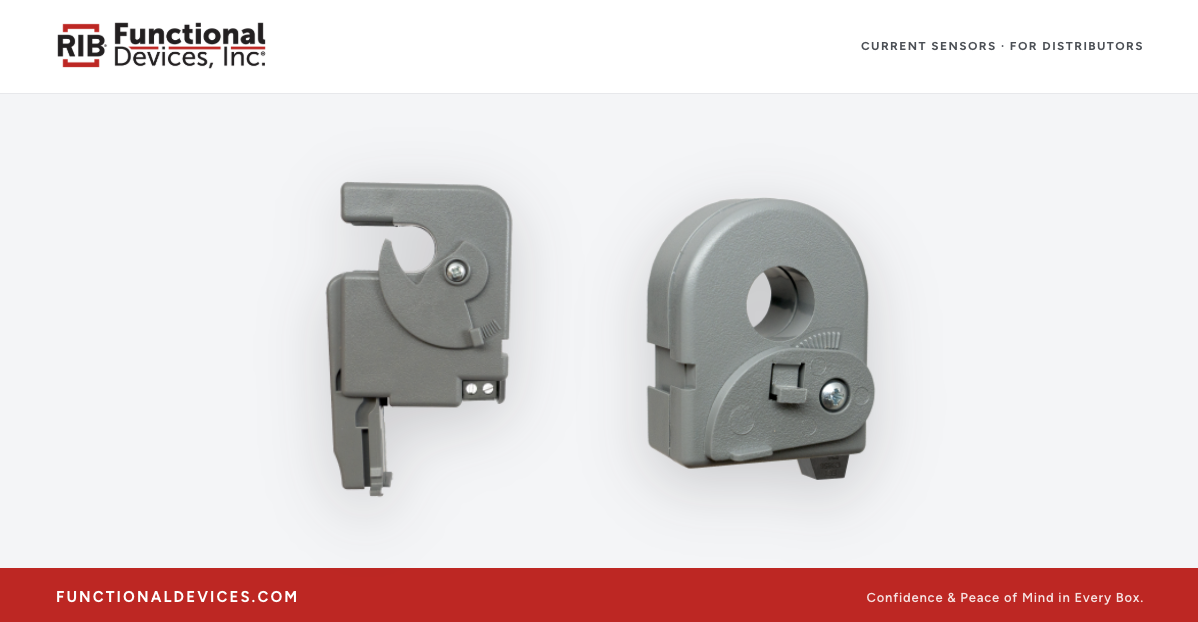
Because the same job that needs a relay to switch a load often also needs a current sensor to confirm that it ran, current sensors for distributors are commonly specified alongside relays. A branch that stocks the relay but not the sensor is more than likely handing that second sale to a competitor.
Functional Devices, Inc. manufactures current sensors—both current switches and 4–20 mA transducers—for building automation, alongside its RIB® (Relay-In-a-Box®) line. This guide covers what these devices do, which SKUs cover the most common applications, and how they pair with relay orders at the counter.

What Current Sensors Are, and Why Distributors Stock Them
A current sensor is built around a current transformer (CT): the CT is the sensing element, and the sensor packages it with output circuitry that turns the sensed current into a usable signal. Within the category, two device types cover almost all demand. A current switch gives a go/no-go answer—a solid-state contact that closes when current crosses a threshold, used to confirm a load is running. A current transducer outputs a 4–20 mA signal proportional to the monitored current, and is used where a controller needs the actual amperage, not just on/off.
Distributors stock current sensors for one practical reason: they add on easily to relay and building automation system (BAS) business already being done. Because the two are commonly specified together, carrying both captures the whole line rather than half of it. The current switches are self-powered, so there is no companion power supply to stock, and a short list of SKUs covers most requests.
Current Sensor Applications for Your HVAC and Panel-Builder Customers
These are the requests a counter sees most often, each tied to a current sensor by function.
- Fan Proving: A current switch on the fan motor confirms the motor is drawing running current, a reliable proxy for fan operation, as a BAS status point that backs up, or in many designs replaces, a sail switch.
- Pump and Motor Status: A current switch verifies a pump or motor is drawing running current, not just that it was commanded on.
- Lighting Verification: A current switch confirms a lighting circuit energized after a relay closed.
- ECM Status: An electronically commutated motor (ECM) draws far less current than a conventional motor, so its running draw can sit below a standard switch's threshold. Low-trip-point sensors distinguish standby draw from running draw.
- Analog Current Monitoring: Where a controller logs current draw or tracks how it changes over time, a 4–20 mA transducer replaces the go/no-go switch.
Which Current Sensors to Stock, by SKU
Three traits distinguish one current switch from the next: solid core versus split core, fixed versus adjustable threshold, and terminal strip versus wire lead. A fourth choice depends on the load, not the switch: a low-current ECM can draw less than a standard switch's threshold detects, so it takes a low-trip-point model. A panel-mount current sensor with terminal-strip output suits panel builders; wire-lead versions suit field installs. All models below are UL Listed, self-powered, and sense up to 150 A.
- RIBXKTF: Solid-core, fixed 0.25 A threshold, terminal strip. The baseline fan- and pump-proving switch for new panels where the conductor can be threaded through the solid core.
- RIBXKTA: Solid-core, adjustable 0.50–150 A, terminal strip. Adjustable version for loads that carry a standby current the switch must sit above.
- RIBXGTA: Split-core, adjustable, terminal strip. The split core opens for installation without disconnecting the monitored wire, which is what retrofits need.
- RIBXGTA-ECM: Split-core, adjustable down to a 0.25 A threshold, terminal strip. Sized for ECM loads where running current is low enough that a standard switch misses it.
For depth, stock the wire-lead equivalents (RIBXKF, RIBXKA, RIBXGF, RIBXGA) for field installers, the self-calibrating RIBXGTA-SCAL for setup without a manual threshold adjustment, and the RIBXK420 / RIBXG420 lines of 4–20 mA transducers for analog monitoring. A minimum branch set of the four terminal-strip switches above covers most HVAC and panel-builder requests with the fewest line items.

How to Bundle Current Sensors With Relay Orders
This pairing is a practical one. A relay commands a load; a sensor confirms it ran. Any control sequence that reports status back to a BAS puts a relay on the output and a current switch on the monitored equipment. So a relay order for fan, pump, or lighting control frequently implies a current-switch need on the same job. Because both come from the same manufacturer, they ship on the same order through an authorized distributor—no second vendor, and no split lead time.
How to Present Current Sensors at the Counter
Plenty of customers order relays without mentioning a sensor. One question determines whether they need one: does the job only have to switch the load, or does it also have to confirm the load ran? If the spec calls for status, feedback, proving, or verification, a relay alone won't cover it; those applications also need a current switch.
A fairly short list of applications drives most of the current sensor demand: fan proving, pump or motor status, lighting verification, and ECM status feedback. Each of these also typically needs a relay, so offering both the relay and current sensor together can prevent the sale from going to another supplier.
Current Sensor FAQs for Distributors
What are the most common current sensor applications for HVAC distributors?
Fan proving, pump and motor status, lighting verification, and ECM status feedback. Each confirms a load is running for a BAS status point, which is why they attach to relay and controls jobs.
Which current sensors should I stock alongside relays?
A workable minimum is four terminal-strip current switches: RIBXKTF (solid-core, fixed), RIBXKTA (solid-core, adjustable), RIBXGTA (split-core, adjustable, for retrofits), and RIBXGTA-ECM (split-core, low-threshold, for ECM loads). Add wire-lead and 4–20 mA transducer models as branch demand warrants.
Are Functional Devices current sensors UL Listed?
Yes. The RIBXK and RIBXG current switch series are UL Listed, with C-UL recognition for Canada. The specific standard designations and any additional approvals—UL864 for fire-alarm applications or California State Fire Marshal listing, for example—vary by model, so confirm the approvals for a given SKU on its current Functional Devices datasheet.
Can I source current sensors and relays from Functional Devices in the same order?
Yes. Both are Functional Devices product lines, so they ship together on one order through an authorized distributor, with no second vendor or separate lead time.

Stock the RIB® Current Sensor Line Alongside Your Relays
To carry the current sensors that attach to relay and BAS orders, browse the Functional Devices RIB® current sensor lineup or become an authorized Functional Devices distributor.